


How Ethash works: optimize mining hardware and efficiency
Most miners assume raw processing power is the deciding factor in profitability. With Ethash, that assumption will cost you real money. Unlike compute-bound algorithms where faster chips always win, Ethash was engineered from the ground up to make memory the bottleneck, meaning your GPU’s memory bandwidth and VRAM capacity matter far more than its shader count. Understanding exactly how Ethash structures its workload, from seed generation through DAG traversal, is what separates miners who consistently earn from those who wonder why their expensive rigs underperform.
Table of Contents
- What is the Ethash algorithm and why does it matter?
- Step-by-step: How Ethash mining actually works
- Why memory matters most: GPU and ASIC efficiency explained
- Real-world mining: Application and optimization strategies
- The uncomfortable truth: What most guides miss about Ethash mining
- Next steps: Find your ideal mining hardware
- Frequently asked questions
Key Takeaways
| Point | Details |
|---|---|
| Memory is critical | Ethash rewards miners with hardware optimized for memory bandwidth and dataset handling, not just compute. |
| DAG grows over time | The DAG dataset’s size increases every 30,000 blocks, impacting hardware requirements and efficiency. |
| GPU viability persists | Despite ASIC advances, GPUs remain competitive for Ethash mining thanks to memory-hard design. |
| Optimize for epochs | Precomputing DAGs and monitoring epoch transitions prevents mining delays and maximizes uptime. |
| Hardware selection matters | Choosing GPUs with sufficient VRAM and high memory bandwidth is the single biggest factor in Ethash mining success. |
What is the Ethash algorithm and why does it matter?
Ethash did not appear out of nowhere. It evolved from an earlier design called Dagger-Hashimoto, inheriting its core philosophy: make mining expensive in memory, not just in computation. As Ethereum.org documents, “Ethash is a memory-hard proof-of-work algorithm derived from Dagger-Hashimoto, designed to be ASIC-resistant by requiring access to a large DAG dataset.” That single design choice shaped the entire hardware landscape for Ethereum mining.
The term “memory-hard” means the algorithm forces hardware to repeatedly read from a large dataset stored in memory. You cannot cache the answers or precompute shortcuts. Every hash attempt requires genuine memory access, which means memory bandwidth, measured in gigabytes per second, becomes the primary performance constraint.
Key terminology every miner needs to know:
- DAG (Directed Acyclic Graph): A large dataset, currently several gigabytes, that miners must store in VRAM and access during every hash attempt
- Cache: A smaller, 16 MB structure generated first, used to build the DAG and also used by light clients for verification
- Epoch: A period of 30,000 blocks after which the DAG grows larger and must be regenerated
- ASIC-resistance: A design goal meaning the algorithm was structured to prevent specialized chips from gaining an overwhelming advantage over general-purpose GPUs
- Memory bandwidth: The rate at which data moves between a chip and its memory, the true performance ceiling in Ethash mining
“The memory-hard design of Ethash means that even the fastest compute chip is only as good as the memory subsystem feeding it data.”
Regarding ASIC-resistance, the story is nuanced. As noted in the Ethereum mining documentation, “Ethash was intended ASIC-resistant but ASICs were developed; GPUs remained viable until Ethereum’s PoW deprecation. Still used in ETC, ETHW.” After Ethereum’s shift to proof-of-stake in 2022, Ethash mining continues on Ethereum Classic (ETC) and EthereumPoW (ETHW), keeping the algorithm relevant for miners today. You can browse current Ethash miners to see what hardware options are available for these networks right now.
Pro Tip: Before buying any Ethash mining hardware, check the current DAG size for ETC. If a GPU or ASIC’s VRAM cannot hold the full DAG, it will either fail to mine or suffer severe performance penalties.
Step-by-step: How Ethash mining actually works
With the basic structure of Ethash established, let’s break down how it operates, step by step, so you can see where hardware bottlenecks and opportunities for optimization arise.
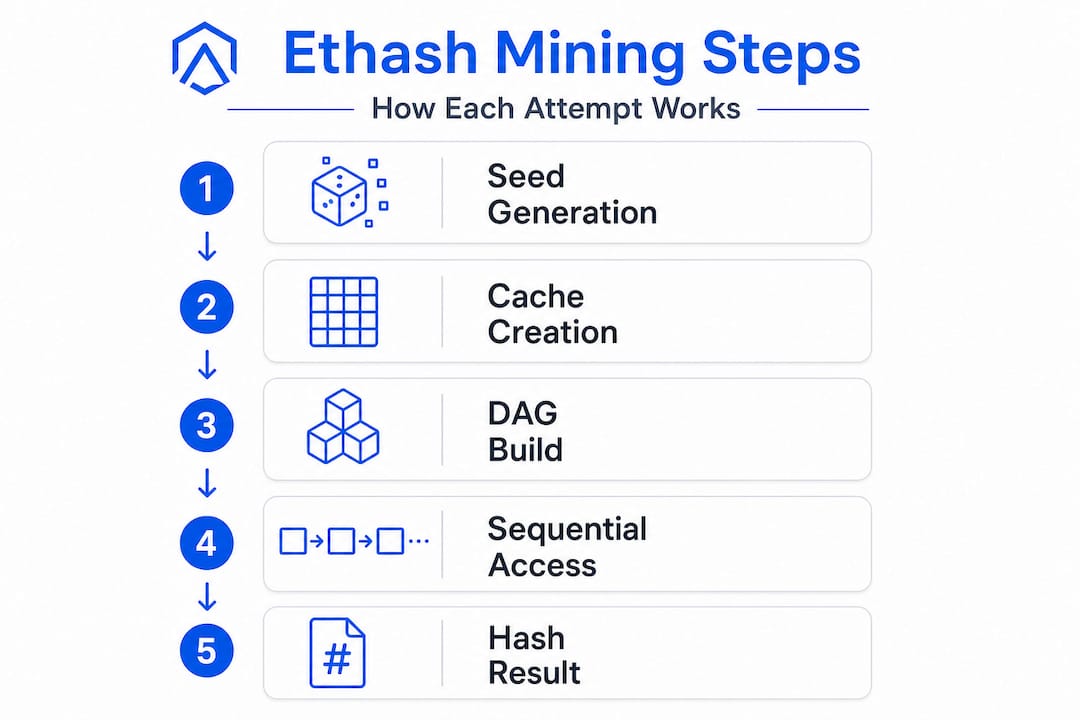
The full process starts with a seed computed from block headers. That seed is used to generate a 16 MB pseudorandom cache. The cache then generates a multi-gigabyte dataset, the DAG, that grows over time with each epoch.
The Ethash mining process, step by step:
- Seed generation: The miner computes a seed value derived from the block header of the current epoch. This seed changes every 30,000 blocks, triggering a new DAG.
- Cache creation: Using the seed, the algorithm generates a 16 MB pseudorandom cache. This step is relatively fast and uses standard CPU or GPU computation.
- DAG generation: The cache expands into the full DAG dataset. For ETC mining in 2026, the DAG is well over 4 GB. This generation takes time and must complete before mining begins.
- Nonce selection: The miner selects a random nonce (a number used once) and combines it with the current block header to form a starting value.
- Hashimoto function execution: As the algorithm specification describes, the hashimoto function “combines block header and nonce into seed, mixes with random 128-byte slices from DAG using FNV hashing over multiple accesses, compresses to produce mixHash and result.”
- Result comparison: The miner checks whether the output hash meets the current network difficulty target. If yes, the block is solved. If no, a new nonce is tried and the process repeats from step 4.
- Epoch transition: Every 30,000 blocks, the DAG must be regenerated. Miners who do not pre-generate the new DAG experience downtime during this transition.
| Ethash component | Size / frequency | Hardware impact |
|---|---|---|
| Cache | 16 MB | CPU or GPU RAM |
| DAG (ETC, 2026) | ~4.5 GB and growing | Requires sufficient VRAM |
| Epoch length | 30,000 blocks (~5 days) | DAG regeneration needed |
| Memory accesses per hash | 64 sequential reads | Memory bandwidth critical |
| FNV mixing rounds | 64 per hash | Moderate compute load |
The 128-byte sequential memory access pattern is the architectural detail that defines everything. Each hash attempt forces the hardware to fetch 64 separate 128-byte chunks from the DAG in sequence. That access pattern is specifically designed to saturate memory buses and prevent computation from outrunning memory delivery.
Why memory matters most: GPU and ASIC efficiency explained
Understanding the stepwise mining operation highlights how hardware interacts with Ethash, so let’s examine which hardware types fare best and how memory bottlenecks shape your choices.
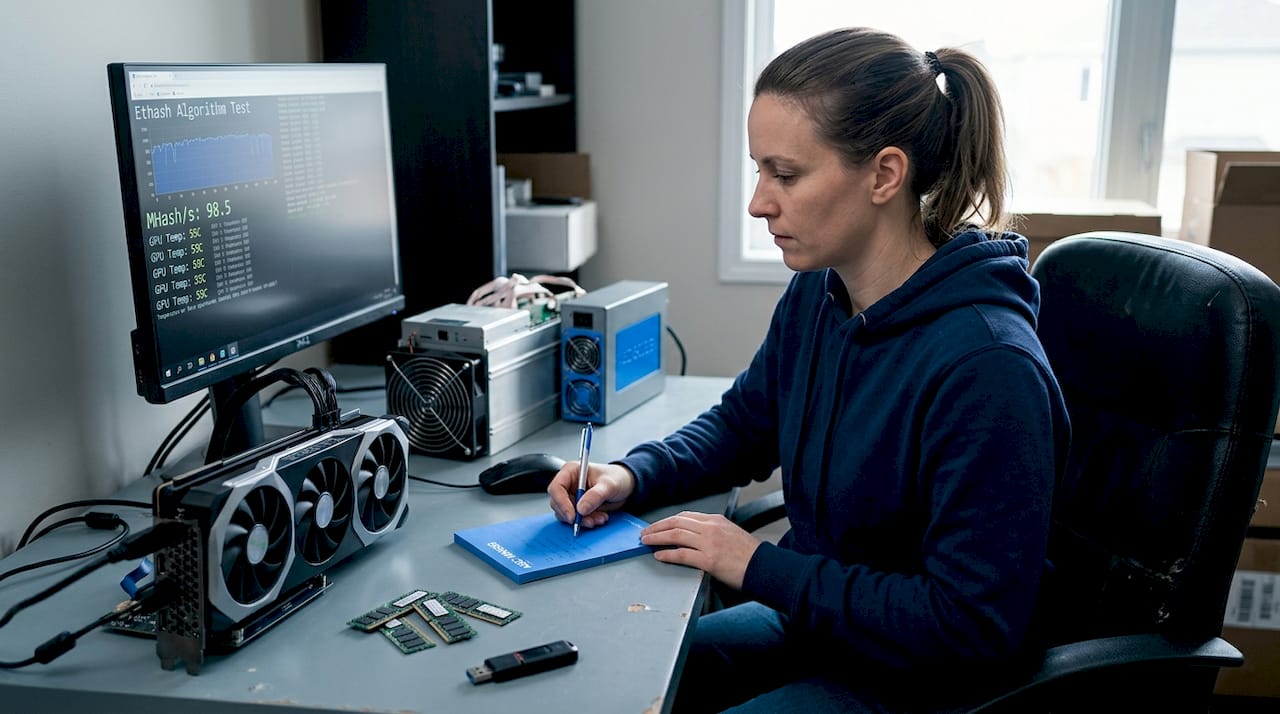
The sequential 128-byte access pattern optimizes for GPU memory patterns, directly disadvantaging pure compute ASICs. Here is why: GPUs were designed from the start to move large volumes of data between processors and memory at very high speed. Their memory subsystems, particularly GDDR6 and HBM variants, deliver hundreds of gigabytes per second of bandwidth. That is exactly what Ethash needs.
Traditional ASICs, built to maximize computation per watt, often have narrower memory interfaces because most algorithms do not require massive memory throughput. When those ASICs hit Ethash’s memory wall, their compute advantage evaporates.
Why GPU architecture aligns with Ethash requirements:
- High memory bandwidth (often 400 to 900+ GB/s on modern cards) matches Ethash’s access demands
- Wide memory buses (256-bit to 384-bit) allow parallel data fetching across multiple DAG accesses
- Large VRAM pools (8 GB to 24 GB) comfortably hold the full DAG without spilling to slower system memory
- GPU firmware and drivers are optimized for exactly this kind of streaming memory workload
That said, Ethash-specific ASICs do exist and they do offer advantages. According to ECIP-1070 analysis, “ASICs offer approximately 1.4 to 2x efficiency over GPUs per some analyses, less than other algorithms, maintaining relative GPU viability.” Compare that to Bitcoin’s SHA-256 algorithm, where ASICs outperform GPUs by thousands of times. The gap in Ethash is narrow enough that well-configured GPUs remain competitive.
| Hardware type | Memory bandwidth | VRAM | Ethash efficiency advantage |
|---|---|---|---|
| High-end GPU (GDDR6X) | 400 to 900 GB/s | 8 to 24 GB | Strong baseline, highly configurable |
| Ethash-specific ASIC | Varies by design | Fixed | ~1.4 to 2x over GPU |
| General compute ASIC | Often limited | Often limited | Poor, memory-bottlenecked |
| Older GPU (GDDR5) | 200 to 350 GB/s | 4 to 8 GB | Viable if VRAM exceeds DAG size |
For miners considering home-use ASIC miners, the Ethash category is one of the few where the ASIC advantage is modest enough that the decision between GPU and ASIC rigs comes down to electricity cost, upfront investment, and flexibility. A GPU rig can switch algorithms; an Ethash ASIC cannot. That flexibility has real dollar value in a shifting market.
Pro Tip: When comparing GPU and ASIC hardware, do not just compare hash rates. Divide hash rate by power consumption to get efficiency in MH/J (megahashes per joule). Then factor in your electricity rate. The winner on paper is often not the winner on your power bill.
Checking out top home ASIC miners can give you a real-world comparison of how current Ethash-capable hardware stacks up against other algorithm options in terms of return on investment.
Real-world mining: Application and optimization strategies
Now that you know how to make informed hardware choices, let’s see how top miners apply these lessons in real-world mining setups.
The single biggest avoidable loss in Ethash mining is epoch transition downtime. Every 30,000 blocks, roughly every five days, the DAG must be regenerated. Miners who wait for the transition to happen before generating the new DAG lose minutes to hours of mining time per transition. Over a year, that adds up to significant lost revenue.
Practical strategies for maximizing Ethash mining efficiency:
- Pre-generate the DAG: Most mining software supports generating the next epoch’s DAG in the background while still mining the current epoch. Enable this feature and verify it is working before each transition.
- Verify VRAM headroom: Your VRAM must exceed the current DAG size with room to spare. Running at 99% VRAM capacity causes instability. Aim for at least 500 MB of headroom above the current DAG size.
- Monitor epoch timing: Track the current block height and calculate when the next epoch transition will occur. Set calendar reminders if needed. Surprises cost money.
- Optimize memory clocks, not core clocks: In Ethash, increasing memory clock speed directly increases hash rate. Increasing core clock speed has minimal effect. Most miners find that underclocking the GPU core while overclocking memory reduces power draw without hurting performance.
- Use stable, proven mining software: Software that handles DAG transitions cleanly and supports background pre-generation is worth more than marginal hash rate differences between software versions.
The Ethereum mining documentation confirms that “DAG must be pre-generated by miners; failure leads to epoch transition delays. Verification uses cache to regenerate needed dataset parts, enabling light clients.” Light clients, like block explorers and wallets, use the smaller cache to verify blocks without storing the full DAG. Miners do not have that luxury; you need the full dataset loaded and ready.
For mining optimization, the guidance is clear: “prioritize GPUs with high memory bandwidth and sufficient VRAM exceeding current DAG size; precompute DAGs to avoid delays.” In practical terms for ETC mining in 2026, that means a minimum of 6 GB VRAM, with 8 GB being the safe floor and 10 GB or more providing comfortable headroom for future DAG growth.
Pro Tip: During a DAG epoch transition, your mining software will show a brief drop in reported hash rate. This is normal. If the drop lasts more than two to three minutes, your DAG pre-generation is not working correctly. Investigate before the next epoch hits.
The uncomfortable truth: What most guides miss about Ethash mining
Most hardware guides treat Ethash like any other algorithm: compare hash rates, pick the winner, start mining. That approach misses the most important variable in your profitability equation.
Memory tuning is not a secondary consideration in Ethash. It is the primary lever. We have seen miners with top-tier hardware earn less than miners with mid-range cards simply because the top-tier setup was not memory-optimized. Running default memory clocks on an Ethash rig is the equivalent of leaving money on the table every single hour.
The ecosystem shift matters just as much. When Ethereum moved to proof-of-stake, the entire Ethash mining community had to pivot to ETC, ETHW, and smaller networks. As the Ethereum documentation notes, Ethash was used in ETC and ETHW after Ethereum’s PoW deprecation. Miners who had already built flexible, memory-optimized rigs adapted quickly. Those locked into single-purpose setups struggled.
The uncomfortable reality is that most guides focus on hardware specs at the moment of purchase and ignore the ongoing management work that actually determines profitability. DAG size grows. Epoch transitions happen every five days. Network difficulty shifts. A miner who treats Ethash as a set-and-forget operation will consistently underperform one who monitors and adjusts regularly.
The algorithm rewards understanding, not just investment. Miners who know why memory bandwidth matters, how the DAG grows, and when to pre-generate the next epoch’s dataset will always outperform those who simply buy the most expensive hardware and hope for the best.
Next steps: Find your ideal mining hardware
If you’re ready to translate your understanding of Ethash into smarter mining investments, the following resources will help you take the next step.
At ASIC Miners, we stock hardware suited to the full range of mining algorithms, including Ethash-capable rigs for ETC and ETHW mining. Whether you’re evaluating your first setup or scaling an existing operation, our catalog covers everything from entry-level options to high-performance units. Explore our Bitmain Antminers overview to see how leading hardware brands approach efficiency across different algorithms. For miners focused on home setups with manageable power requirements, our guide to best ASIC miners for home use breaks down the real-world tradeoffs between cost, performance, and electricity draw. Every purchase comes with worldwide shipping, warranty coverage, and direct customer support.
Frequently asked questions
What makes Ethash different from other mining algorithms?
Ethash is memory-hard by design, requiring miners to repeatedly access a large DAG dataset stored in VRAM, which shifts the performance bottleneck from computation to memory bandwidth and helps limit ASIC dominance compared to compute-bound algorithms like SHA-256.
How often does the Ethash DAG dataset increase in size?
The DAG updates every 30,000 blocks, approximately every five days, growing linearly over time and requiring miners to regenerate and reload the dataset into VRAM at each epoch transition.
Can ASICs still mine Ethash efficiently?
Ethash ASICs exist and offer a modest efficiency advantage of roughly 1.4 to 2x over GPUs, but because Ethash’s memory requirements limit how much ASICs can leverage their compute advantages, GPUs remain viable for ETC and ETHW mining.
What hardware specs are most important for Ethash mining?
Miners should prioritize high memory bandwidth and VRAM capacity that exceeds the current DAG size, since these two factors directly determine how efficiently a card can execute the sequential 128-byte memory accesses that define Ethash’s workload.